Dubai Short-Term Rental Strategy 2026: Airbnb Economics, Licensing and the Unit Types That Actually Clear 9% Net
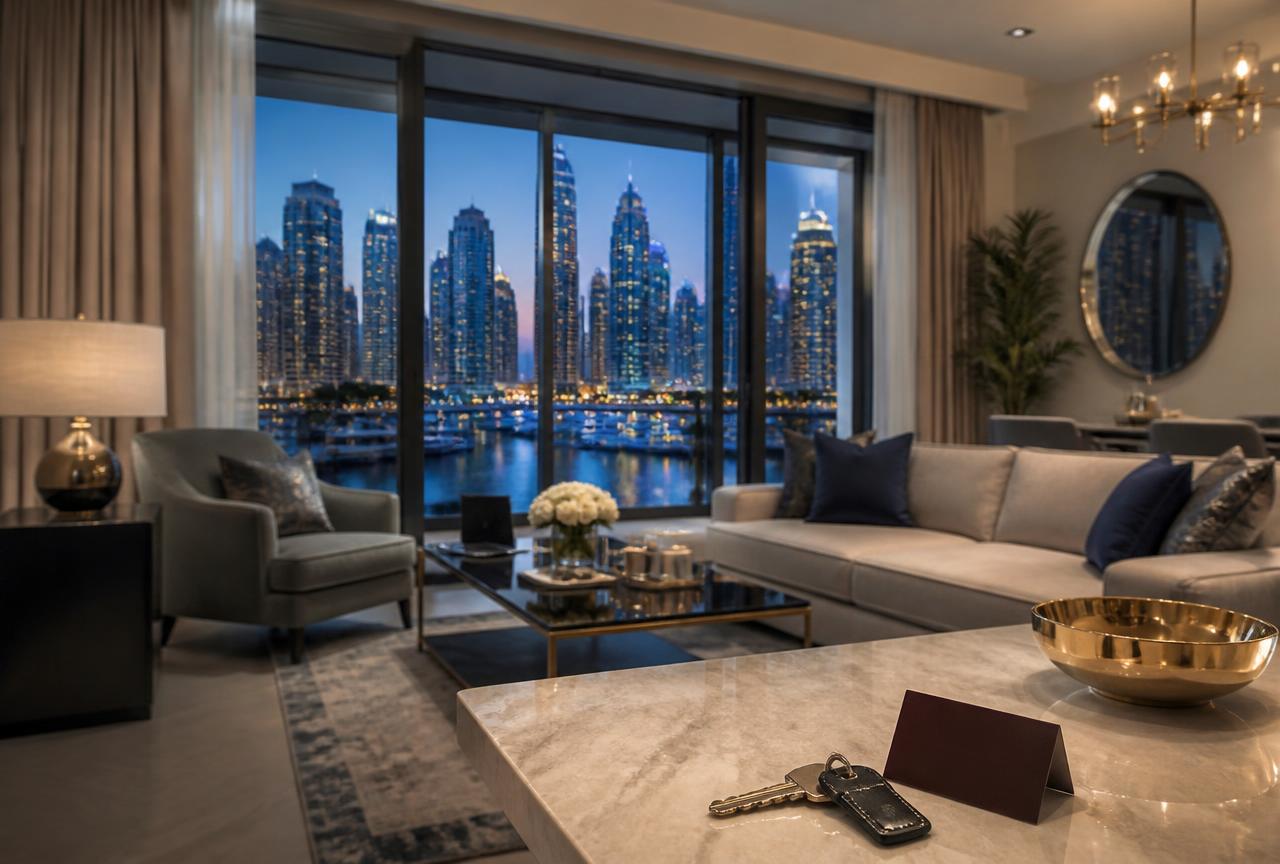
A working operator's model for Dubai holiday homes in 2026 — DET licensing, Tourism Dirham, real occupancy curves by district, the cost stack that quietly eats gross yield, and how the numbers change between Marina, JVC, Downtown and Palm Jumeirah.
Why Dubai's short-term rental market changed shape
Dubai received more than 18 million international overnight visitors in 2024 and continued growing through 2025, according to the Department of Economy and Tourism. That volume of arrivals, concentrated into a compact set of waterfront and downtown districts, is what makes holiday-home letting in Dubai structurally different from most global cities: demand is not seasonal tourism layered onto a residential market, it is a permanent hospitality demand stream that residential stock is allowed to serve.
The regulatory picture matured alongside it. Dubai formalized holiday-home licensing years before most competing markets, and by 2025 roughly 40,000 units held active permits. That is a large number, and it cuts both ways. It means the model is legitimate, bankable and serviced by a professional operator ecosystem. It also means an unremarkable one-bedroom with generic furniture and no reviews is competing against tens of thousands of alternatives on the same three booking platforms.
The practical consequence for a 2026 investor is that the question is no longer whether short-term letting works in Dubai. It is which specific unit, in which specific building, under which specific operating model, still clears a net return worth the additional complexity over a simple annual lease.
The licensing framework you must satisfy first
Short-term letting in Dubai is a licensed tourism activity administered by the Department of Economy and Tourism through its holiday-homes program. The permit attaches to the unit. You can hold it personally as an owner-operator, or a licensed operator can hold it on your behalf under a management agreement — the second route is how most overseas owners do it.
What the permit requires
Registration requires proof of ownership or a tenancy contract with the owner's written consent, Emirates ID or passport of the applicant, a DEWA account in the correct name, and photographs of the fully furnished unit meeting the classification standard. Units are graded, and the grade influences both the permit fee band and the Tourism Dirham charged per night.
Once permitted, the unit must be listed with its permit number, guest data must be registered on arrival, and the property must remain compliant with fire, safety and furnishing standards. Enforcement is real: unlicensed listings are routinely delisted and fined.
Tourism Dirham and VAT
The Tourism Dirham is charged per bedroom per occupied night and collected from the guest. Treat it as a pass-through in your model, never as a deduction from your net rate.
Short-term accommodation is a taxable supply for UAE VAT purposes. Once annual taxable supplies exceed the mandatory registration threshold, registration with the Federal Tax Authority is compulsory and 5% VAT applies to the nightly rate. Single-unit owners frequently sit below the threshold; multi-unit portfolios rarely do. See the Federal Tax Authority for current thresholds.
Where the money actually comes from: ADR, occupancy and seasonality
Short-term revenue is the product of three variables: average daily rate, occupancy and length of stay. Dubai's peculiarity is a genuinely bimodal year. From November to April the city runs at hotel-grade occupancy with premium rates. From late June to early September, daytime temperatures suppress leisure demand and rates compress sharply, sometimes by 40% or more against the winter peak.
Amateur models fail because they take a January nightly rate, multiply by 365 and apply a flat 80% occupancy. A realistic model builds four seasonal blocks and applies a different rate and occupancy assumption to each.
| District | Peak ADR (AED) | Summer ADR (AED) | Annualized occupancy | Typical entry price (1BR) |
|---|---|---|---|---|
| Dubai Marina / JBR | 750 – 1,100 | 380 – 520 | 78% – 85% | AED 1.5M – 2.2M |
| Downtown Dubai | 850 – 1,300 | 420 – 600 | 75% – 84% | AED 1.9M – 2.8M |
| Palm Jumeirah | 1,100 – 2,200 | 550 – 950 | 72% – 82% | AED 2.6M – 4.5M |
| Business Bay | 550 – 800 | 300 – 420 | 72% – 80% | AED 1.1M – 1.6M |
| JVC | 380 – 550 | 230 – 320 | 70% – 78% | AED 700K – 1.0M |
| Dubai Creek Harbour | 600 – 900 | 330 – 470 | 68% – 76% | AED 1.4M – 2.0M |
The cost stack that decides your net yield
Gross revenue is the number operators advertise. Net yield is the number you live on. In Dubai the gap between the two is wider than most first-time owners expect, because short-term letting converts a passive asset into an operating business with consumables, labor and depreciation.
- **Management fee** — 15% to 25% of gross revenue for a full-service licensed operator, sometimes structured as a lower base plus performance share.
- **Cleaning and linen** — charged per turnover; on short average stays this is the second-largest variable cost and scales with booking count, not revenue.
- **Utilities and internet** — DEWA, chiller and high-speed broadband are the owner's cost in short-term letting, unlike an annual lease where the tenant pays.
- **Service charges** — the annual per-square-foot community charge, payable regardless of occupancy.
- **Furniture and consumables depreciation** — realistically a four to five year replacement cycle on soft furnishings in a high-turnover unit.
- **Permit, Tourism Dirham administration and compliance** — modest in absolute terms but non-optional.
- **Platform commission** — where the operator does not absorb it, typically 3% to 15% depending on channel and cancellation policy.
- **Vacancy and rate compression** — the summer months, not a line item but the largest single drag on annual net.
| Line | Annual amount (AED) | Note |
|---|---|---|
| Gross booking revenue | 246,000 | Blended ADR 790 at 80% occupancy, net of platform discounting |
| Management fee (18%) | -44,280 | Full-service licensed operator |
| Cleaning and linen | -27,500 | Approx. 110 turnovers |
| Utilities, chiller, internet | -16,800 | Owner-paid in short-term model |
| Service charges | -19,600 | Approx. AED 18 per sq ft on 1,090 sq ft |
| Permit, compliance, insurance | -6,500 | DET permit, liability cover |
| Furniture depreciation reserve | -14,000 | AED 70,000 fit-out over 5 years |
| Net operating income | 117,320 | — |
| Net yield on purchase price | 6.7% | Excludes capital appreciation and acquisition costs |
Short-term versus annual lease: the honest comparison
The same Marina unit on a standard annual lease might contract at AED 135,000 to AED 150,000 with the tenant paying utilities. Against that, the short-term model above produced AED 117,320 net — less, on a pure income basis, after all operating costs.
That result surprises people, and it is exactly why the comparison must be made unit by unit. Short-term letting outperforms annual letting in Dubai under three specific conditions, and underperforms without them.
When short-term wins
First, when the unit sits inside the tourist demand map and commands a genuine ADR premium — waterfront, view, walkability to attractions. Second, when the entry price is low relative to achievable ADR, which is why compact JVC and Business Bay studios often post better net percentages than trophy Palm units. Third, when the owner values flexible personal use, which an annual lease eliminates entirely.
When an annual lease wins
Suburban and family-community stock, large three-bedroom units with high service charges, buildings with restrictive community rules, and any owner who wants a genuinely passive asset. An annual lease in Dubai is typically paid in one to four cheques with the tenant absorbing utilities and minor maintenance — that simplicity has real value.
For a fuller treatment of the passive route, read our Dubai property management guide for overseas landlords.
Choosing the unit: what experienced operators actually buy
The best-performing holiday-home units share a recognizable profile, and it is not the profile most investors instinctively choose.
- **One bedroom, not studio, not three.** One-bedrooms capture couples, business travelers and small families, the three largest Dubai booking segments, and they turn over faster than large units.
- **A real view, or none at all.** A marina, sea or Burj view justifies a rate premium that pays for itself within two seasons. A partial view of a neighboring tower does not.
- **Walkable location.** Guests without cars book what is near the beach, the metro, the mall or the marina walk. A ten-minute taxi to anything costs you rating points.
- **Building amenities that photograph well.** Pool, gym and a serviced lobby are effectively part of your listing inventory.
- **Low service charge per square foot.** This is a permanent drag; an AED 24 per sq ft building is structurally worse than an AED 15 per sq ft building with equivalent ADR.
- **Confirmed permission for nightly letting.** Non-negotiable, in writing, before exchange.

Operating model: self-manage, hybrid or full service
Three models dominate, and the right choice depends far more on your location and time than on your spreadsheet.
How to vet an operator
Ask for their DET permit number, the number of units under management, their portfolio-wide occupancy and ADR over the last twelve months, and their payout schedule. Then ask for two owner references with units similar to yours. Operators who route revenue through their own accounts and pay net monthly should provide a statement showing gross bookings, platform fees and every deduction line — if the statement only shows a net figure, keep looking.
| Model | Cost to owner | Owner time | Best for |
|---|---|---|---|
| Full-service licensed operator | 15% – 25% of gross | Under 1 hour/month | Overseas owners, first-time investors |
| Hybrid (owner prices, operator services) | 8% – 14% plus per-clean fees | 3 – 6 hours/month | Hands-on owners in a compatible time zone |
| Self-managed with own DET permit | Direct costs only | 10 – 20 hours/month | Dubai residents with 1 – 2 units |
A case study in getting it wrong, then right
A European buyer purchased a two-bedroom in a peripheral community in 2023 at AED 1.35 million, attracted by the low price per square foot. Modeled at AED 600 ADR and 80% occupancy, it looked exceptional. Reality delivered AED 340 ADR, 58% occupancy, high cleaning costs on a large unit and a community that restricted nightly letting halfway through the second year.
The unit was sold and replaced with a one-bedroom in a Marina tower at AED 1.62 million with confirmed permission and a view. Blended ADR came in at AED 760 with 79% occupancy in year two, and net operating income moved from roughly AED 41,000 to roughly AED 112,000 — on an asset costing 20% more.
The lesson is unglamorous: in short-term rentals, demand location and building permission outrank price per square foot every single time.
Financing, tax and reporting for overseas owners
Non-resident mortgage financing is available for holiday-home purchases, though some lenders price short-term use less favorably or require a long-term lease declaration — clarify intended use at application rather than after drawdown. Our Dubai mortgage guide for non-residents covers loan-to-value bands and documentation.
On the UAE side, individual rental income is untaxed, VAT applies to short-term accommodation above the registration threshold, and corporate tax may apply to structured ownership. On your home-country side, the income is almost certainly reportable where you are tax resident. Our Dubai property tax guide for foreign investors sets out the reporting obligations by jurisdiction.
Verify ownership, service-charge history and permit status directly through the Dubai Land Department and the Dubai REST application before committing, and confirm current holiday-home rules with the Department of Economy and Tourism.
Your 2026 execution checklist
Short-term rental investing in Dubai rewards operators, not speculators. If you work the following sequence in order, the model behaves predictably.
- Confirm the building permits nightly letting, in writing, before you offer.
- Build a four-season revenue model, not a flat annual average.
- Price the full cost stack including furniture depreciation and summer compression.
- Apply the 1.6x screening test against the achievable annual lease.
- Shortlist three licensed operators and compare audited portfolio performance, not brochures.
- Budget the fit-out properly — furniture is revenue equipment, not decoration.
- Price aggressively for the first ninety days to build review volume.
- Review ADR and occupancy monthly against the model and adjust rather than hoping.
Conclusion
Dubai remains one of the few global cities where nightly letting is explicitly licensed, professionally serviced and supported by structural tourism demand rather than a regulatory grey zone. That legitimacy is the opportunity. It is also why the easy money has been competed away: the market now pays for operational quality, not for merely owning an apartment.
Investors who buy inside the demand map, confirm permission, model four seasons honestly and hire a serious operator continue to clear net yields in the 6% to 9% range with meaningful upside from rate growth. Investors who buy on price per square foot and hope for 85% occupancy discover the cost stack the expensive way.
This article is informational and does not constitute financial, tax or legal advice. Confirm current permit requirements, fees and thresholds with the Department of Economy and Tourism, the Dubai Land Department and the Federal Tax Authority, and take licensed professional advice before purchasing.
Frequently asked questions
Is Airbnb legal in Dubai?
Yes, but only with a holiday home permit issued by the Department of Economy and Tourism (DET). Renting a unit nightly without that permit is an unlicensed tourism activity and carries fines, listing takedowns and possible building-level bans. The permit is tied to the specific unit, not to the owner.
How much does a Dubai holiday home license cost?
Owners operating in their own name pay an annual permit fee scaled to unit size, plus a DTCM registration charge and the per-night Tourism Dirham collected from guests. Budget a few thousand dirhams a year per unit for permit and compliance, before management or platform fees.
What is the Tourism Dirham?
It is a per-occupied-night municipality fee that holiday-home operators collect from guests and remit to the authorities. It is charged per bedroom per night and varies by grade of accommodation, so it should be modelled as a pass-through line, not absorbed from your nightly rate.
What occupancy should I model for a Dubai short-term rental?
A professionally managed, well-reviewed one-bedroom in a tourist district typically settles between 75% and 85% annualized once it has a review history. Model the first year at 60% to 65% while the listing builds ranking, and expect a genuine summer trough from June to early September.
Does short-term letting really beat an annual lease in Dubai?
On gross revenue, almost always. On net, only with disciplined operations. Short-term gross can run 1.5x to 2x an annual lease, but management at 15% to 25%, utilities, internet, cleaning, consumables, furniture depreciation and vacancy typically absorb 35% to 45% of that gross.
Which Dubai areas perform best for holiday homes?
Dubai Marina, JBR, Downtown Dubai and Palm Jumeirah lead on average daily rate and occupancy because they sit inside the tourist demand map. Business Bay and JVC deliver lower nightly rates but far lower entry prices, which often produces a similar or better net yield percentage.
Can I run a Dubai Airbnb from abroad?
Yes. Most overseas owners appoint a licensed holiday-home operator that holds the DET permit, handles check-in, cleaning, pricing and compliance, and remits net income monthly. Self-managing from another time zone is possible but rarely survives contact with a 2 a.m. lockout.
Do building owners' associations block short-term rentals?
Some do. A growing number of communities restrict or prohibit nightly letting through their community rules, and a few developers enforce it strictly. Confirm the building's position in writing before you buy — this is the single most common post-purchase shock.
What does furnishing a Dubai holiday home cost?
A rentable mid-market one-bedroom fit-out generally lands between AED 45,000 and AED 90,000 including appliances, linen sets, kitchenware and photography. Premium buildings need premium furniture to hold their nightly rate, so under-furnishing a luxury unit is a false economy.
Is short-term rental income taxed in the UAE?
The UAE levies no personal income tax on individual rental income. VAT at 5% applies to short-term accommodation supplies once you cross the mandatory registration threshold, and corporate tax may apply if you operate through a company. Your home country will usually still tax the profit.
How long before a new listing stabilizes?
Plan for three to six months. Platform algorithms reward review volume and response rates, so early pricing should be aggressive enough to fill nights and generate reviews rather than to maximize the first quarter's revenue.
What is the single biggest mistake first-time owners make?
Buying a unit that models beautifully in a spreadsheet but sits outside the actual tourist demand map, in a building that later restricts nightly letting. Verify demand and permission before you verify the yield.
Related in Rentals
 RENTALS
Dubai Property Management for Overseas Landlords 2026: Costs, Ejari, Service Charges and Net Yield
 RENTALS
Dubai Holiday Home License 2026: How to Legally Run an Airbnb and What It Pays
 RENTALS